
ANFA Sport Entertainment Provisional Scheme
ANFA — Antarctic National Football Association | Official Game Rules & Standards
ANTARCTIC NATIONAL FOOTBALL ASSOCIATION
ANFA
Official Rulebook, Field Standards & Broadcast Regulations
First Edition · 2025
Abstract
The Antarctic National Football Association (ANFA) presents a codified framework of rules, field specifications, player conduct standards, scoring systems, and broadcast regulations for the sport of Association Football as practised under its jurisdiction. This article provides a comprehensive academic and administrative review of the ANFA game model, which departs from legacy international standards in several purposeful and innovative ways, including an expanded squad format of fifteen starting players per team, a unique octagonal centre-circle field architecture, a technology-assisted player coordination system based on smart wearable devices, and a differentiated scoring tier that awards distinct point values for goals, free kicks, and penalty goals. The ANFA field measures 134 metres in length and 104 metres in width, totalling approximately 13,000 square metres or 3.2 acres. Match duration is structured around four periods of 25 minutes each, with mandatory team side-switching at every interval. This article also addresses club identity standards, including trademark and certification requirements for team logos, and sets out broadcast standards for television and digital media distribution. The regulatory intent of these rules is to promote competitive fairness, tactical innovation, player safety, and global spectator engagement within the unique cultural and geographical identity of Antarctic football.
1. Introduction
The Antarctic National Football Association (ANFA) was established to govern, promote, and regulate the sport of football in a manner that honours the unique environmental, cultural, and logistical context of Antarctic sporting life. Football, as a global sport, has long been governed by a single dominant set of international laws; however, the ANFA recognises that regional associations may develop codified rule sets suited to their specific contexts, provided those rules promote fairness, safety, spectacle, and integrity.
ANFA football retains the essential spirit of the game: two teams compete on a rectangular pitch, the ball is moved primarily by foot, and the objective is to score more points than the opposing team within the allotted time. However, ANFA introduces several structural departures that significantly expand the tactical and physical demands of the game. The inclusion of fifteen-player starting line-ups, a four-quarter match format, a tiered points system, and smart-watch-assisted play coordination represent bold innovations with clear sporting rationale.
This document serves as the primary reference for all ANFA-affiliated clubs, match officials, broadcast partners, and commercial licensees. It is structured to cover field dimensions and markings, player and squad regulations, officiating procedures, match timing and restart protocols, scoring and points allocation, club identity certification, and sports entertainment and television standards. All provisions contained herein supersede any conflicting prior guidance and are effective from the date of first publication.
2. Field of Play — Dimensions and Markings
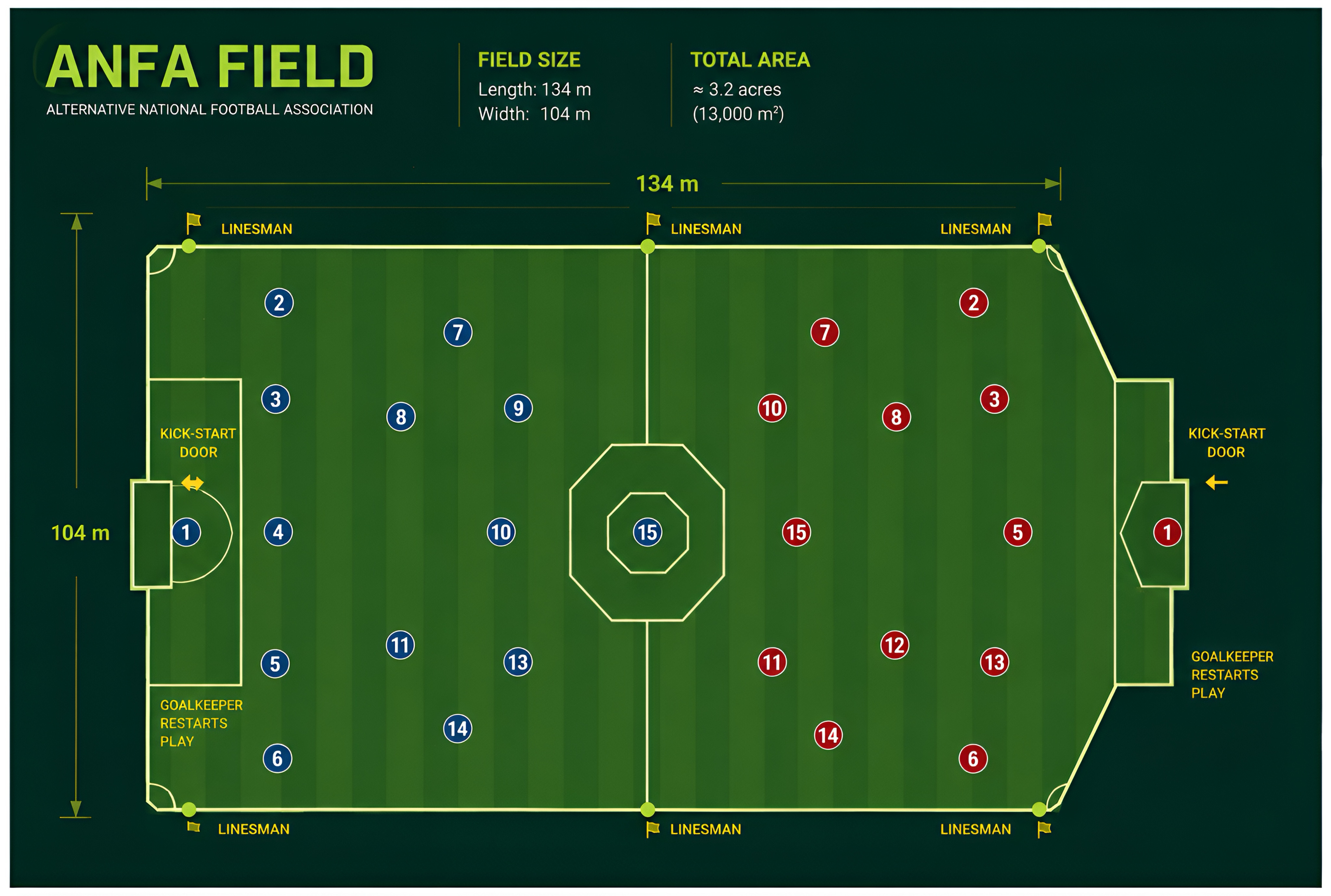
The ANFA field of play, referred to hereinafter as the 'ANFA Field', is a rectangular surface with specific dimensions and marking requirements designed to support fifteen-player formations and the associated tactical demands of the game.
2.1 Overall Dimensions
• Length: 134 metres
• Width: 104 metres
• Total Area: approximately 13,000 square metres (≈ 3.2 acres)
The surface must be natural or artificial grass of regulation quality, uniformly maintained and marked in compliance with ANFA Field Standards. Pitch markings shall be rendered in high-visibility yellow-white paint or equivalent approved material.
2.2 Boundary and Corner Markings
The field is bounded by touchlines (the two longer sides) and goal lines (the two shorter sides). Corner areas are demarcated with quarter-circle arcs of one-metre radius. Corner flags are mandatory at all four corners and at the mid-points of each touchline. The mid-point flags serve as linesman reference markers and are maintained by the officiating staff.
2.3 Centre Circle and Octagonal Zone
A defining and distinctive feature of the ANFA Field is the octagonal central marking, which replaces the traditional circular centre circle. This octagonal zone is inscribed at the centre of the field and serves as the primary neutral zone during kick-start procedures. Within it, a smaller concentric circle marks the exact kick-start point. The geometry of the octagonal zone encourages wider spread of defensive positioning during kick-offs and creates a more visually distinctive tactical area.
2.4 Goal Structure
Goals are positioned centrally on each goal line. The goal specifications are as follows:
• Width (internal): 7.35 metres
• Height (internal): 2.45 metres
Goals must be constructed from approved metal or composite materials and must include nets securely fastened to the frame and ground anchors. The goalkeeper's area is demarcated by a rectangular box extending six metres from each post and six metres into the field of play. A larger penalty area extends eighteen metres from each post and eighteen metres into the field.
2.5 Kick-Start Door
An innovation unique to ANFA is the designated Kick-Start Door — a marked zone located on the right side of each goal area perimeter. This zone indicates the mandatory kick-off entry point for players entering or re-entering the field after goal scoring events and at the start of each quarter. The Kick-Start Door is a spatial marker, not a physical barrier, and is clearly painted and signposted at field level.
3. Teams, Players, and Squad Regulations
3.1 Team Composition
Each ANFA match is contested between two teams. Each team shall field exactly fifteen (15) players at the commencement of each quarter. Players occupy specialised positional roles as determined by their team's tactical formation, and all player positions must be registered with the match official prior to kick-off.
Player numbering follows the ANFA squad number system in which shirt numbers correspond to positional designations. As shown in the ANFA Field diagram, player numbers 1 through 15 are assigned to specific zones of the field, with Number 1 being the designated Goalkeeper for each team.
3.2 Reserve Players
Each team is permitted to register up to five (5) reserve players per match. Reserves may be introduced to the field exclusively in the following circumstances:
• A registered starting player sustains an injury that prevents continuation of play
• A registered starting player receives a disqualification from the match official
Reserves are considered precious resources within the ANFA system. They may not be used for tactical substitutions in the conventional sense. Once a reserve player has entered the field, the departing player may not return. Each team may use a maximum of five reserve substitutions across the entire match, regardless of the cause.
3.3 Player Conduct and Field Presence
Only registered players are permitted to be present on the field of play at any time during active match proceedings. No coaching staff, medical personnel, team officials, administrative employees, or any other individual affiliated with either club may enter the field of play during live play.
In the event of a player injury, the match official (Linesman) may temporarily pause play to permit a certified field technician to assess the injured player from the boundary of the field. The field technician is the sole non-playing individual authorised to approach the field perimeter during a pause, and must exit immediately upon resumption of play. Under no circumstances shall the technician enter the field surface.
3.4 Use of Hands — Goalkeeper Exception
ANFA football is fundamentally a foot-sport. All outfield players (Numbers 2 through 15) are strictly prohibited from using their hands or arms to control, redirect, pass, or otherwise interact with the ball at any time during play. The sole exception to this rule is the designated Goalkeeper (Number 1) for each team, who is permitted to use their hands and arms exclusively within the boundaries of their own penalty area.
Any deliberate handling of the ball by an outfield player shall result in a free kick awarded to the opposing team from the point of the infringement, and may, at the discretion of the officiating Linesman, result in a personal caution or disqualification depending on intent and consequence.
4. Match Officials and Smart Technology
4.1 Officiating Structure
ANFA matches are officiated by a panel of Linesmen stationed at designated positions along the touchlines and behind the goal lines. Unlike traditional officiating structures, ANFA does not employ a single central referee on the field. Instead, the officiating panel operates exclusively from the perimeter of the field, communicating decisions via authorised electronic signalling systems.
The Linesman panel consists of a minimum of four officials per match: one stationed at each mid-touchline flag and one behind each goal line. Officiating decisions are collective where practical, with the senior Linesman holding final authority in disputed calls. The use of perimeter-only officiating reinforces the principle that no employees or non-players may be present on the field surface.
4.2 Smart Watch Technology for Players
All registered players are required to wear ANFA-approved smart watches throughout the duration of each match. These devices serve multiple coordinated functions within the game system:
• Tactical scheme delivery: coaching staff may relay approved tactical formations and positional adjustments to players via the smart watch interface during pre-play intervals and designated communication windows
• Official orders: Linesmen may transmit official match instructions, warnings, and restart coordinates to players during stoppages
• Health monitoring: the devices monitor basic biometric data including heart rate and movement, assisting the field technician in rapid assessment of potential injuries
• Positioning compliance: smart watch alerts may notify players if they breach designated positional zones during set-piece formations
Smart watches must be ANFA-certified, tamper-proof, and configured to receive only approved transmissions from the officiating panel and registered team communication systems. Any attempt to use smart watch systems for unsanctioned communications or tactical interference during live play shall constitute a serious breach of ANFA regulations and may result in team sanctions.
5. Match Duration, Timing, and Restart Procedures
5.1 Match Structure
An ANFA match consists of four equal periods (Quarters) of twenty-five (25) minutes each, totalling one hundred (100) minutes of regulation play. There is no provision for conventional half-time as in two-period formats; instead, three interval breaks of ten minutes each are observed between Quarters.
Stoppage time may be added at the discretion of the senior Linesman at the end of any Quarter to compensate for time lost due to injuries, official stoppages, or other qualifying interruptions. The Linesman's stoppage time determination is final and is announced via the smart watch system to all players simultaneously.
5.2 Quarter Transitions and Side-Switching
At the conclusion of each Quarter, both teams switch ends of the field. This means that the team defending the left-hand goal in Quarter One will defend the right-hand goal in Quarter Two, and so forth. Side-switching occurs at every Quarter break without exception.
The practical consequence of this arrangement is that the kick-start location — fixed on the right side of the field — will alternate in terms of which team's half it falls within across Quarters. This ensures symmetric competitive conditions across the full match.
5.3 Kick-Start Procedures
The home team holds the right to begin the match and therefore takes the first kick-start of Quarter One. The kick-start is always executed from the right side of the field, from within the designated Kick-Start Door zone adjacent to the octagonal centre area.
Following every goal, play is restarted by the team that conceded the goal, also from the Kick-Start Door on the right side of the field. This rule ensures consistent restart geography regardless of which team scored.
In cases where no goal has been scored and a stoppage has been caused by the ball leaving the field of play (out-of-bounds), the Linesman signals the restart from the closest marked restart location on the field perimeter. The team that did not last touch the ball before it went out of play retakes possession at the designated closest restart point. Play resumes on the Linesman's whistle.
5.4 Goalkeeper Restart
When the ball passes fully over the goal line — having last been touched by an attacking player — and no goal is awarded, the Goalkeeper restarts play. The ANFA Field designates specific Goalkeeper Restart zones in the lower corners of each half (as shown in the field diagram). The Goalkeeper may roll, throw (within their penalty area), or kick the ball from these zones to resume play.
6. Scoring System and Points Allocation
One of the most distinctive features of ANFA competition is the differentiated scoring system. Rather than treating all goals as equal, ANFA assigns distinct point values to goals depending on their method of creation. This tiered system rewards different aspects of skill and creates a richer strategic dimension to match management.
6.1 Open Play Goal — 3 Points
A goal scored from open play — that is, any goal that is not the direct or immediate result of a free kick or penalty award — is worth three (3) points. Open play goals include all goals arising from general attacking build-up, corner kicks, throw-ins leading to direct shots, goalkeeper restarts leading to goals, and any other situation not classified under the free kick or penalty categories. The open play goal is the highest-value scoring action in ANFA and reflects the greatest degree of collective tactical achievement.
6.2 Free Kick Goal — 2 Points
A goal scored directly from a free kick award — whether a direct free kick or an indirect free kick subsequently converted in one further touch — is worth two (2) points. Free kicks are awarded for fouls, handling offences, and other technical infractions as determined by the officiating Linesman. The free kick goal acknowledges the skill involved in set-piece execution while distinguishing it from the higher complexity of open play.
6.3 Penalty Goal — 1 Point
A goal scored from a penalty kick is worth one (1) point. Penalties are awarded for serious fouls or deliberate handball committed by a defending player within the penalty area. While the penalty represents an advantageous scoring opportunity, its conversion under pressure is a recognised skill, and the one-point value reflects both the opportunity created by the defending team's infringement and the tactical disruption it causes. A missed penalty results in no points and a Goalkeeper restart.
6.4 Match Outcome
The team with the highest cumulative point total at the conclusion of the fourth Quarter is declared the winner. In the event of an equal points total at full time, the match is recorded as a draw for league purposes. ANFA competition regulations separately govern tiebreaker procedures for knockout and championship rounds, which may include extra periods or a designated tiebreaker sequence as specified in the competition framework.
7. Disciplinary Standards and Player Conduct
7.1 Cautions and Disqualifications
The ANFA officiating panel may issue cautions (equivalent to a formal warning) and disqualifications (removal from play) for breaches of the laws of the game. A player receiving two cautions within a single match is automatically disqualified and must leave the field immediately. A disqualified player may be replaced by a registered reserve, subject to reserve availability.
Disqualifications for violent conduct, serious foul play, or deliberate dangerous behaviour may result in the player being suspended from subsequent ANFA matches as determined by the ANFA Disciplinary Committee.
7.2 Fouls and Misconduct
Fouls are defined as any unlawful physical challenge against an opponent, including but not limited to: tripping, pushing, holding, charging recklessly, jumping at an opponent, or making contact with an opponent before the ball. Fouls committed outside the penalty area result in a direct free kick. Fouls within the penalty area result in a penalty kick. The distinction between intentional and unintentional fouls is considered by the Linesman in determining the severity of the sanction.
Verbal abuse, dissent toward officiating decisions, deliberate time-wasting, and unsporting behaviour are all subject to formal caution. Repeated dissent after a caution is grounds for immediate disqualification.
7.3 Smart Watch Misuse
Any player found to be using their ANFA smart watch device to receive unauthorised external communications, relay information to non-registered parties, or tamper with officiating signals shall be immediately disqualified. The team may also face a points deduction at the discretion of the ANFA Integrity Panel. Smart watch transmissions are subject to real-time monitoring by ANFA-certified technical officials stationed outside the field.
8. Club Identity Standards — Logos, Trademarks, and Certification
8.1 Logo Design Requirements
Every football club competing under ANFA jurisdiction is required to maintain a registered club logo that meets ANFA's Creative Identity Standards. Club logos must be original, creative, and reflective of the club's identity, history, or geographic character. Generic or derivative designs will not be approved for registration. The following design requirements apply:
• The logo must be a wholly original graphic work, free from unlicensed reference to existing commercial trademarks, flags of sovereign nations, or prohibited symbols
• The design must be reproducible at multiple scales without loss of legibility or visual integrity — scalability from 16×16 pixels to full-size stadium branding is required
• Colour palettes must be submitted in both RGB and CMYK profiles, with Pantone equivalents provided for printing standards
• Logos must include a text element bearing the club's registered name in a legible typeface approved by ANFA's Design Registry
• Logos shall not incorporate photographic imagery, human likenesses, or artificial intelligence-generated visual elements without prior written approval from ANFA
8.2 Trademark Registration
Prior to participation in any ANFA-sanctioned competition, clubs must submit their logo and full visual identity package — including home and away kit designs, badge variants, and wordmark formats — to the ANFA Trademark and Certification Office (TCO). The TCO will review submissions within thirty (30) working days and issue either a Certificate of ANFA Brand Compliance or a formal request for amendment.
Upon certification, the club's logo and associated marks are registered on the ANFA Intellectual Property Register, affording the club protected usage rights within ANFA-governed contexts. Registered clubs may use the ANFA certification seal on all official materials. Unauthorised use of the ANFA seal or the registered marks of another club is subject to legal action under ANFA commercial regulations.
8.3 Kit and Apparel Standards
All playing apparel — including jerseys, shorts, socks, and goalkeeper kits — must conform to ANFA Kit Regulations. Shirts must clearly display the player's official squad number on the back in a minimum 20-centimetre height numeral. The club badge must appear on the upper left chest. A mandatory ANFA competition patch must be worn on the right sleeve for all official matches. Kit designs must be registered with the TCO alongside the club logo.
9. Sports Entertainment Standards — Television and Digital Broadcast
9.1 Broadcast Rights and Licensing
ANFA holds the exclusive authority to license broadcast rights for all matches played under its jurisdiction, including domestic league matches, cup competitions, and international fixtures. No broadcaster may transmit audio, visual, or data coverage of an ANFA match without a valid and current Broadcast Licence Agreement issued by the ANFA Media Rights Office. Broadcast licences are issued on a territorial basis and must be renewed prior to each competition season.
9.2 Television Production Standards
Licensed broadcasters must adhere to ANFA Television Production Standards to ensure consistent, high-quality viewer experience across all markets. The minimum production requirements for match coverage are as follows:
• Live match coverage must be produced in a minimum resolution of 4K Ultra High Definition (3840 × 2160 pixels) at 50 or 60 frames per second
• A minimum of twelve (12) camera positions must be deployed for each match, including elevated main cameras, goal-line cameras, player tunnel cameras, and smart watch data overlay feed cameras
• HDR (High Dynamic Range) production is strongly recommended and will be mandatory for premium broadcast tiers from the 2026 season onwards
• Commentary must be available in a minimum of two languages for international distribution, with additional language feeds encouraged
• Real-time player biometric data, where authorised by ANFA's player data agreement framework, may be incorporated into broadcast graphics overlays
9.3 In-Match Graphics and Data Overlay
Broadcasters are encouraged to deploy advanced data visualisation during live coverage. ANFA provides a certified data feed to licensed broadcast partners containing live match statistics, player positioning data derived from the smart watch system, points tally, and formation tracking. The data overlay package is delivered in real time via ANFA's secure broadcast data API.
All on-screen graphics must comply with ANFA's visual identity guidelines, using approved colours and typography consistent with ANFA branding. Third-party graphic packages may be used provided they are approved in advance by the ANFA Media Standards Committee.
9.4 Digital and Streaming Distribution
ANFA recognises the primacy of digital distribution in contemporary sports media. Licensed streaming platforms must maintain minimum service standards including:
• Uninterrupted streaming quality of no less than 1080p HD for standard tier subscribers
• 4K streaming for premium tier subscribers, with Dolby Atmos audio where platform capability permits
• Maximum buffering delay (latency) of no more than eight seconds from live action to viewer delivery for standard streams; two seconds for ultra-low-latency premium products
• Captioning and accessibility services for hearing-impaired viewers are mandatory on all licensed streaming platforms
• Geo-restriction compliance in accordance with territorial licence agreements
9.5 On-Site Media Operations
A designated media area must be established at all ANFA-sanctioned match venues. This area shall include a press tribune with individual workstations for a minimum of forty accredited journalists, a mixed-zone corridor for post-match player interviews, a designated broadcast compound for outside broadcast vehicles, and secure data connectivity for live data feed transmission. Broadcasters' technical staff are permitted in the broadcast compound and press tribune only and may not access the field perimeter during live play.
9.6 Advertising and Commercial Presentation
ANFA matches may carry commercial advertising within the broadcast feed subject to the following standards: advertising must not interrupt live play; commercial breaks are permitted during Quarter intervals and other official stoppages only. Pitch-side LED advertising boards must be approved by ANFA and must not create visual interference for players or match officials. Virtual advertising inserted into the broadcast feed must be clearly distinguishable from actual pitch markings and must not simulate officiating signals or game events.
10. Conclusions
The Antarctic National Football Association (ANFA) has established a forward-thinking and internally coherent set of game rules, administrative standards, and broadcast regulations that represent a significant and purposeful evolution of football governance. The ANFA model addresses the needs of a modern, technologically integrated sport whilst preserving the fundamental appeal and physical demands that make football the world's most widely followed sport.
The expansion of team size to fifteen starting players per side creates a richer tactical landscape, demanding greater squad depth, superior spatial awareness, and more sophisticated positional discipline than conventional formats. Paired with the four-quarter structure, which introduces an additional layer of physical and strategic management, ANFA football tests the full breadth of a squad's capabilities across a complete match.
The tiered scoring system — three points for open play goals, two for free kicks, and one for penalties — is among the most impactful rule innovations. By creating meaningful differentiation between types of goals, ANFA transforms score management into a multidimensional strategic exercise. A team leading on open-play goals faces different tactical decisions than a team leading on penalty accumulation, and this complexity elevates the intellectual dimension of both playing and watching the sport.
The integration of smart watch technology into the officiating and communication framework represents ANFA's commitment to technological advancement in sport governance. Player coordination via wearable devices reduces ambiguity in tactical communication, enables more precise officiating through data, and opens new possibilities for real-time health monitoring and player welfare. The strict controls on smart watch usage — prohibiting unauthorised transmissions and requiring ANFA certification — ensure that this technology serves integrity rather than undermining it.
The club identity standards, with their emphasis on original creative logos, rigorous trademark registration, and formal certification, protect the commercial and cultural assets of ANFA clubs whilst maintaining a consistent standard of professionalism across the association. These standards ensure that ANFA's visual identity, and that of its member clubs, is distinctive, legally protected, and commercially viable.
Finally, the broadcast and digital media standards establish ANFA as a broadcast-ready organisation from inception. By mandating 4K production, multi-language commentary, accessible streaming services, and transparent data distribution, ANFA positions itself to deliver a world-class viewing experience to audiences regardless of platform or geography. The commitment to accessibility and data integration reflects a modern understanding of how sports organisations build and sustain global audiences.
In sum, ANFA represents a thoughtfully designed sporting institution whose rules promote fairness, reward skill, embrace technology, and prioritise the experience of players, officials, and spectators alike. The association's regulatory framework provides a stable and comprehensive foundation for the development of Antarctic football as a recognised and respected sporting code on the world stage.
Appendix A — ANFA Quick Reference Summary
Field Specifications
• Length: 134 m | Width: 104 m | Area: ~13,000 m² (3.2 acres)
• Goal: 7.35 m wide × 2.45 m high
• Centre marking: Octagonal zone with inner kick-start circle
• Kick-Start Door: Right side of field
Match Format
• 4 Quarters × 25 minutes = 100 minutes regulation time
• Teams switch ends at every Quarter break
• Home team begins; kick-start always from right side of field
• After every goal: restart from Kick-Start Door (conceding team)
Squad
• 15 starters per team
• Up to 5 reserves (injury or disqualification only)
• No employees on field — players and perimeter technician only
Scoring
• Open play goal: 3 points
• Free kick goal: 2 points
• Penalty goal: 1 point
Key Rules
• All players must use feet only — goalkeepers (No. 1) may use hands in own penalty area
• Smart watches mandatory for all players
• All clubs must hold ANFA trademark and logo certification
• Broadcasts: minimum 4K, 12 cameras, multi-language, accessible streaming
— End of ANFA Official Rulebook, First Edition 2025 —
© 2025 Antarctic National Football AssociationPage